Tuesday, April 29, 2014

Swimming Creatures Ocean Box

So as promised, I have a few pics here of the start of our ocean box.  I used about 1/3-1/2 of a [Dollar Tree] blue tablecloth, instead of paper.  It looks wavy and watery and it'll do.  I snagged a box from the local grocery store (they were more than happy to unload it on me) to create the main frame of this ocean box project. And there was no out of pocket expense. Yeah.


The bottom of the ocean was suppose to be made from various kid-made stuff but hey, we had real sand, coral and all sorts of ocean things to use-so we went for the real look.  I just took clear packing tape, stuck two pieces together and then taped it on the sides and bottom of the box. This created a lip to keep the sand from spilling out and all over.


I guess as we move through each unit of study we will add various creatures to this.  Sounds like fun and I will post as we go.  Oh and don't you know, as soon as this was all set up-we had our first residence arrive (who will not stay) to await the addition of new creatures.

LOL....oh Sponge Bob...this isn't Bikini Bottom.  


Tuesday, April 22, 2014

Apologia Science: Swimming Creatures of the Fifth Day ideas

We are excited to start working through the Apologia Swimming Creatures (student text) study.  I put our sea critter decorations up, that I found [at the local Dollar Tree Store] last summer, and have patiently waited to use.  They are obviously out of proportion but they do add some whimsical-ness to our classroom.


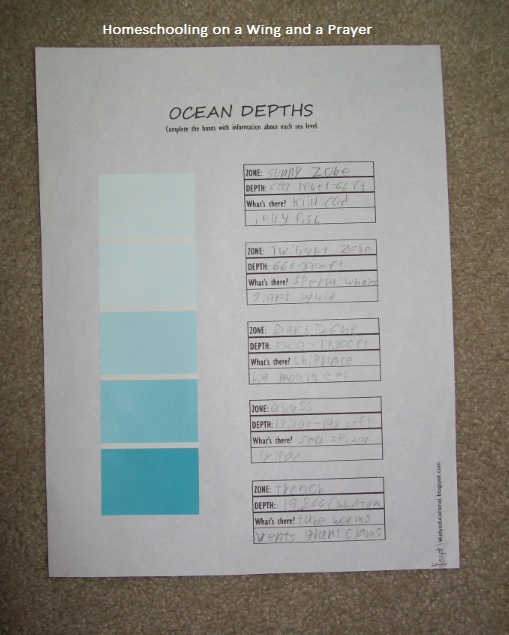
Product DetailsWe are using the spiral bound notebook journal that compliments the study, just like we did with the Flying Creatures.  I decided to also add an ocean depths worksheet from the Deceptively Educational Blog, which is a fun activity to do.  You just need to grab a paint chip sheet with varying shades of blue (5 blocks) for the student to glue to the page.  I found one in my mass collection of paint chips that I picked up a few years ago before we painted the boys' room, so I am not sure exactly where I got it.  Just look in the paint section of the home improvement stores for some.

We haven't started the ocean box (yet) that is part of the hands-on part of the study-but once we get that going I will add pictures for you.  Objective number one is to procure a box from the local grocery store then the blue paper (but me thinks a blue table cloth from the dollar store will work even better) first.  Hopefully, I can get that done this week.

Anyhoo-that is where we are in our science now.


Wednesday, March 19, 2014

Montessori Geography/Continent Box -so excited to share our homemade version

So back in September I posted that I wanted to make a Montessori Geography box (I had seen an awesome example on Pinterest).  I found an old, smelly and 'in great need of care' silverware box [the type that many a bride received for her wedding which was quite popular in the 1950s-70s] that would be perfect for the project.  It was marked $2 or $3 but I talked it down to a whopping dollar bill! My goal for this project was to spend as little as possible and I actually managed to do just that as the total overall cost was under $10!


SO I had the box and I knew what I wanted to do with it-but it took many steps to accomplish. That was September remember?  Due to some health issues, then the holidays then tucking it aside to then finding it and saying, "OH yeah-need to finish this!"-it took longer to get done than it should have.  So to start, I had to allow for at least a month of 'freshening' to get rid of the musty smells. That meant ripping out the gross felt and little doodads that were meant to hold the silverware. That helped eliminate some stench-but then I had to scrap off (as best as possible) the ugly glue, then rub the wood down with bleach water, then place the box in the sun to further the process. At night I placed a bowl of water with bleach in it inside the box, closed the lid and let it continue working on degrossifying it. I learned that trick from Martha Stewart many years ago.
Yes, it was that gross!

When it was finally ready for the box compartments, I sent the hubby and son on a search and find mission.  Thankfully we live in a sub that still has construction going on and since my hubby has spoken to several of the building crews before about scrap wood, it was not a problem finding some luan wood for this. Frankly, with the layering of that wood I can say it was a pain to work with. So if you decide to do something similar-look for a piece of wood that is one solid sheet and not layered together due to it's inherent need to split.  Anyway, I decided how I wanted the boxes to be and ordered my cut pieces from my handyman hubby.  Due to the glue issue (that was under the felt) I had two pieces of luan cut to lay down over them to give me a fresh look. Then he cut a few strips to build the boxes.  That was the hard part. We do not have a mini-Norm Abram workshop about the homestead.  But we made due and I am quite pleased with the results.


After the liquid nails (glue used to adhere it) dried we were ready for paint (I did sand down the wood to avoid splinters) and after several coats it is complete.

I found scrapbook paper I liked (at Hobby Lobby) and just cut it to fit.  
I took slightly watered down white glue (poor man's Mod Podge) to adhere 
it to the top, then coated the entire top/outside with a thick layer to protect it.  

Furthermore, I also have to print and laminate the maps I want to go on the interior lid of the box. I will put little Velcro dots on it to allow for easy map changes, which means all maps will have the dots as well so they will adhere to the main lid area.  This is key to multi-use flexibility.  If I just slapped a pre-school/K level map onto it, I could not use it for a variety of things I have in mind. Especially since I am using this with an older elementary student (right now) but want to be able to use it for future younger students as well.  Oh, and we need to put a hinge on the backside of the lid. Since the original hinges are small, are at least 40+ years old and with the additional weight from the the luan, it needs that additional hinge support.  I highly recommend doing that as well if you make your own.


I did paint the box sections to match the Montessori color code for learning the continents.  I also included a box for Antarctica!  This is important because several countries have territorial claims to it.  I therefore made 8 sections. One for each continent and one for what I am calling the control box. That is where the collection of items to be sorted go.  I will do a separate post on different things that I hope to do with our box as soon as I get all that done.  One step at a time-LOL.

Example using stamp cards for different continents.  Antarctica is not shown b/cuz I have not received the stamps yet but you get the general idea.  The map that would be used would be the general color-coded continent map for Montessori.  I will link all the sources in the post about how to use the box once I have that completed. 


Sunday, February 2, 2014

Nature Study: Goldenrods

A fun late summer time nature study activity. 
*Be aware of insects that are attracted to these. 
I think I remember seeing lots and lots wasps around them. 
When we started our study [we were going to do this for our co-op group lesson but the day was cancelled so my kids and I did this activity alone], we did some research and read through the story the On One Flower by Anthony D. Fredericks [got thru the library]. It is geared for pre-K through about 3rd grade level but it has great artwork and is a good intro book, so it should it work for most situations. I actually didn't find too many stories relating directly to the Goldenrod-so this was the best I could do.  We then moved to the Handbook of Nature Study by Anna Botsford Comstock.  We read pages 503-506 and did lesson 132 noted in this section.

Essentials:  Tool kit [they each have their own-I just took a pic with one] with all the goodies: magnifying glasses, paints, pencils, tweezers, erasers, and so on. It was early Oct. when we did this so the flowers were moving into the end of their season,so there were not many fresh and full flowering Goldenrod to collect.  But we only need two-so we were happy with that and put them into the flower press to have for their notebook page.

The kids' field study sheets. 

You can see the obvious difference between a 10 yr old and a 17 yr old's work.  I do not require the younger kids to get too detailed, unless they choose to do so.  They both still had to add the Latin names, and the boy needed to add a poem to his page when I took this picture but it gives you an idea of what you should aim for.  Once they had added some color to their flower and had done the other noted things, they went into their Nature Study binders.  I also brought along my camera to take some nice color pictures.  You could also just print a few pics and have your child glue those into their notebook page. This is a great option for children with low frustration thresholds or for those who are young/have dexterity issues.

Goldenrod in the field


look at that ugly bug!  

Nature study: Rocks and Gems

Please Note: I have updated this post that originally was posted on my Charlotte Mason blog.

A year back we used the Considering God's Creation program for my son's science. When we covered the Rocks and Gems section, I used the following books and resources to cover this unit.

So in true CM fashion, we set up an area for displaying our rock collection.  It was very easy to get a collection going [we live in a sub that was built on an old gravel pit so the rocks are literally everywhere] which was fun to display. The egg carton [I switched to the clear egg cartons so we could label them and still see what we had] served as a nice tote for the rocks which kept them organized and in one place.

 *all books are from the library, and you need a big variety due to there being so many rocks-the cross reference is necessary. Unless you have a geologist/petrologist in the family. The elephant carving was a gift  :) but that is soapstone, so it counts.
There are only a couple of these pages from the Considering God's Creation student workbook. I made copies [permissible as noted in the front of the guide] as I wanted the boy to do quite a few pages to document more of the rocks we found.

Wednesday, January 29, 2014

Chronicles of Narnia study helps

File:Narnian.world.map.jpg
from Wikipedia

The Chronicles of Narnia are pure excellence. Not only do they qualify under Charlotte Mason's idea for living books, they are the epitome of a well-written story that envelopes the listeners (and the reader I might add) drawing them in with ease. That is what I strive to provide for my children. A love of a story and the eagerness to listen to it unfold as they are drawn to it and ask for "one more chapter" to be read.

Product Details
Complete Chronicles of Narnia

Following CM's ways, I would ask the children to tell me what they remembered. Then I added some copywork and (at times) some lapbook mini-book snippets. After we read the stories we also watched as many movies as we could find (yes, even the older versions that are a bit lame but still useful).

Product Details
Everything Guide to Narnia

Product Details
Complete Idiot's Guide to Narnia
                          
Companion to Narnia, Revised Edition: A Complete Guide to the Magical World of C.S. Lewis's The Chronicles of Narnia
Companion to Narnia
images from amazon.com

Lapbook Links:

The Horse and His Boy via Homeschool Share
The Magician's Nephew lapbook via Homeschool Share
The Lion, the Witch and the Wardrobe lapbook via Homeschool Share

Miscellaneous links:


Nature Study notebooking helps and examples

Providing a good nature study foundation for your student, is one of the most rewarding aspects of Charlotte Mason.

How to go about it:

You can start out simply enough by just focusing on reading books about a certain subject. That will provide a nice springboard to stir up some interest. Slowly add in an afternoon stroll around your yard, neighborhood, or a local park-of course this depends on the season.  Take note of the type of birds, trees, animals and plants you see.  Even if that is simply mental notes or a couple pictures.  Then when you get home, look up the finds (via the internet, books) and discuss them.

After a few times of this, it can easily grow into a more organized, detailed study.  Use the resources available to you. Remember, you do not need to reinvent the wheel to do this! There are plenty of creative and handy folks who have pulled together studies, books and all sorts of ideas to get you on your nature study path.

Now when those moments arise when you simply are befuddled about what something is or what it does, be sure to admit to your students.  You do not need to be a walking encyclopedia on all things nature like.  AND you don't have to be artistically inclined to do nature studies or the notebooking aspect. The true object to refine your observation skills, to truly see the Glory of our Heavenly Father. It is not about how well you can sketch.  If you feel you and your students need some art instruction, by all means-add it.  There are plenty of "how to" books available.  Try your library first, go through their collection and only purchase the ones that best fit your family.  It takes time, but the results are life changing.

Some examples of NS books


Copywork and art project from Spears Art Studio-High School Curriculum


Sketches by teen-still life and pine cone study/leaf study


The boy's sketches using Barb's
Nature Study with the Outdoor Hour Challenges pages

Additional Helps:

One can add many different forms to their 3-Ring Binder, using a variety of sources, notebook pages and ideas.  I find this method works great because a child can add, shift around projects as they build their collection,  and even categorize their works. I use the Handbook of Nature Study by Anna Comstock a lot.  Barb's studies tie directly into this book, and are easy to implement. I find quotes from the Bible various other sources.

Having a good supply of paper, colored/drawing pencils, erasers, crayons, watercolor paints, scissors (for snipping specimens), and any other medium you can use to sketch, or capture your NS moments is a great way to stay "ready".  We keep our goodies in plastic, snapped totes so we can take them with us while we travel, do specific studies, and so forth.  Don't forget tweezers, variety of magnifying glasses, bug catchers, and a butterfly net to help you corral your findings, so you can sketch them too.

Helpful Links:


Keeping track of your eBook Lapbooks and Lapbook kits: Organization idea

One of the biggest issues I have with all my eBook Lapbook downloads, as well as the actual lapbook kits I own, is that I almost always forget I have them!  Why? Because most of them are eBooks so they are not visually in front of me unless I tap into my files on my computer. I grew tired of missing opportunities to use the components because I simply forgot about them. So I simply took a screen shot of the covers, then put about 4 per page (in MS Word) to print them.  I had some clear, 4 pocket sheet protectors so I sized the covers to match those dimensions. You could prob'ly even use a 6-8 pocket page by simply shrinking the cover size to fit.  Then I placed them into a 3-Ring binder.  So now when I need to see what I have in my inventory, all I have to do is pull the binder out and take a look.  Simple but extremely useful!